
ACS800 Drive User Manual: A Comprehensive Guide
This comprehensive guide details the Abb Acs800-04 drive‚ offering insights into its features‚ functionalities‚ and streamlined workflow capabilities for enhanced productivity.
The ACS800 drive represents a significant advancement in industrial motor control‚ designed to optimize performance and efficiency across a wide range of applications. This manual serves as your primary resource for understanding and utilizing the full potential of your new ABB ACS800-04 drive. It’s crafted to guide users through every stage‚ from initial installation and commissioning to advanced configuration and troubleshooting.
The ACS800 family is renowned for its robust design‚ intuitive interface‚ and comprehensive feature set. Whether you’re a seasoned professional or new to variable frequency drives (VFDs)‚ this guide provides clear‚ concise instructions and valuable insights. It details the drive’s capabilities‚ ensuring seamless integration into your existing systems and maximizing operational uptime. Welcome to a new experience in motor control!
ACS800 Drive Family Overview
The ABB ACS800 drive family is a versatile range of variable frequency drives (VFDs) catering to diverse industrial needs. Specifically‚ the ACS800-04 and ACS800-04M modules‚ ranging from 45 to 560 kW‚ are highlighted in dedicated hardware manuals. This family is engineered for applications demanding high performance‚ reliability‚ and energy efficiency.
The ACS800 portfolio includes options for various mounting styles‚ enclosure types‚ and control functionalities. It’s designed to seamlessly integrate into both new installations and retrofit projects. Understanding the nuances of each module within the family – like the ACS800-04/U4 – is crucial for optimal system configuration. This overview provides a foundational understanding of the ACS800’s breadth and depth‚ preparing you for detailed exploration of specific models and features.

Key Features and Benefits
The ABB ACS800 drive delivers substantial benefits‚ including enhanced process control and significant energy savings. Its robust design ensures reliable operation in demanding industrial environments. Key features encompass a wide voltage range‚ built-in protection functionalities‚ and advanced control modes like scalar and vector control.
Users experience streamlined workflows through intuitive control panel operation and comprehensive parameter settings. The ACS800’s compatibility with various communication protocols – Modbus RTU‚ Ethernet/IP‚ and Profibus DP – facilitates seamless integration into existing automation systems. Furthermore‚ its diagnostic capabilities and fault code reporting minimize downtime and simplify troubleshooting‚ ultimately boosting overall productivity and reducing operational costs.
Safety Precautions and Warnings
Prior to installing or operating the ABB ACS800 drive‚ carefully review all safety precautions and warnings to prevent potential hazards. This equipment operates with high voltages and currents‚ posing risks of electric shock‚ burns‚ and equipment damage.
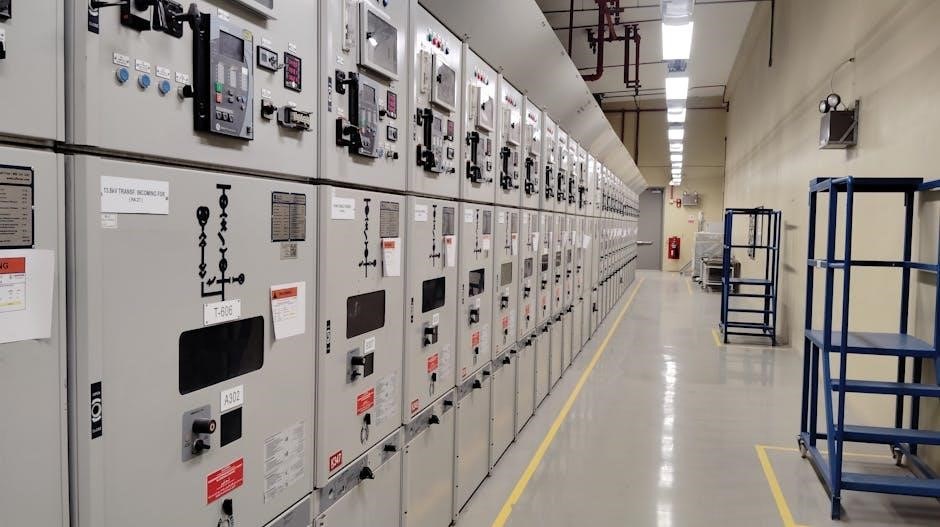
Always ensure the drive is properly grounded and that all electrical connections are secure. Qualified personnel should perform installation‚ commissioning‚ and maintenance procedures. Never operate the drive with damaged cables or components. Disconnect power before accessing internal parts. Adhere to local safety regulations and wear appropriate personal protective equipment. Ignoring these warnings could result in severe injury or fatality. Regular inspections are crucial for safe and reliable operation.

Drive Hardware Components
The ABB ACS800 drive comprises several key hardware components essential for its functionality. These include the Drive Module (ACS800-04/M)‚ responsible for power conversion and control‚ and the user-friendly Control Panel and Display‚ providing interface for parameter adjustments and monitoring.
A robust Power Supply and Connections system ensures stable operation. Additional components may include braking resistors‚ chokes‚ and output filters‚ depending on the application. Understanding the function of each component is vital for proper installation‚ troubleshooting‚ and maintenance. Refer to the ACS800 Hardware Manual for detailed specifications and diagrams of these crucial drive elements.
5.1 Drive Module (ACS800-04/M)
The ACS800-04/M Drive Module forms the core of the drive system‚ handling the power conversion process from AC input to AC output for motor control. Designed for applications ranging from 45 to 560 kW‚ it utilizes advanced IGBT technology for efficient and reliable operation.
This module incorporates sophisticated control algorithms and protection features. The ACS800-04/U4 and ACS800-04M drives are described in detail within the ACS800 Hardware Manual‚ outlining its internal structure and functionalities. Proper understanding of the Drive Module is crucial for correct configuration and troubleshooting‚ ensuring optimal performance and longevity of the entire drive system.
5.2 Control Panel and Display
The ACS800 drive features an intuitive control panel and display‚ providing a user-friendly interface for monitoring and adjusting drive parameters. This interface allows for local operation‚ parameter adjustments‚ and fault diagnostics without requiring external tools.
The display presents critical information such as motor speed‚ current‚ voltage‚ and fault codes‚ enabling quick identification of potential issues. Navigating the control panel is straightforward‚ offering access to various menus and settings. Understanding the control panel’s functionalities is essential for efficient drive operation and maintenance‚ facilitating quick responses to changing process demands and ensuring optimal system performance.
5.3 Power Supply and Connections
Proper power supply and connections are crucial for the reliable operation of the ACS800 drive. The drive requires a stable and appropriately rated power source‚ adhering to specified voltage and frequency tolerances. Careful attention must be paid to input and output phase connections‚ ensuring correct sequencing to prevent damage.
Connections include dedicated terminals for power input‚ motor output‚ control signals‚ and grounding. Grounding is particularly important for safety and electromagnetic compatibility. Always verify wiring diagrams and follow local electrical codes during installation. Incorrect connections can lead to drive malfunction‚ motor damage‚ or pose a safety hazard. Secure connections and appropriate cable sizing are essential for optimal performance.
Installation and Commissioning
Successful installation and commissioning of the ACS800 drive require meticulous attention to detail and adherence to safety guidelines. The process begins with careful mechanical installation‚ ensuring adequate space for ventilation and proper mounting to a suitable surface. Following this‚ electrical installation involves connecting the drive to the power supply‚ motor‚ and control circuitry‚ strictly following wiring diagrams.
Initial startup necessitates verifying all connections and performing preliminary parameter settings. This includes configuring motor data‚ speed limits‚ and basic protection features. A phased commissioning approach‚ starting with low-speed tests and gradually increasing load‚ is recommended to validate proper operation and identify any potential issues before full-scale deployment.
6.1 Mechanical Installation
Proper mechanical installation is crucial for reliable ACS800 drive operation and longevity. Begin by selecting a suitable location‚ ensuring sufficient space around the drive for adequate ventilation – maintaining clearances as specified in the hardware manual is vital. The drive should be mounted vertically on a clean‚ flat‚ and non-combustible surface‚ capable of supporting its weight.
Secure mounting prevents vibrations and ensures stable operation. Verify that the mounting hardware is appropriate for the surface material and drive size. Consider ambient temperature and humidity levels‚ protecting the drive from direct sunlight‚ dust‚ and corrosive substances. Always follow the manufacturer’s guidelines for mechanical installation to avoid potential damage or performance issues.
6.2 Electrical Installation
Electrical installation of the ACS800 drive demands strict adherence to safety regulations and wiring diagrams. Before commencing‚ ensure the main power supply is disconnected and locked out/tagged out. Verify proper grounding to prevent electrical shock and minimize electromagnetic interference. Use appropriately sized cables and terminals‚ conforming to local and national electrical codes.
Carefully connect the power supply‚ motor cables‚ and control wiring‚ double-checking polarity and connections. Implement suitable overcurrent protection devices‚ such as fuses or circuit breakers‚ to safeguard the drive and connected equipment. Always inspect wiring for damage before energizing the system. Incorrect electrical installation can lead to drive failure‚ motor damage‚ or personal injury.
6.3 Initial Startup and Parameter Settings
Upon completing electrical installation‚ proceed with initial startup cautiously. Before applying power‚ re-verify all connections and ensure proper grounding. During the first power-up‚ observe the drive’s display for any initial error messages. Crucially‚ configure essential motor data parameters‚ including rated voltage‚ current‚ frequency‚ and speed.
Accurate parameter settings are vital for optimal drive performance and protection. Begin with basic settings and gradually refine them based on application requirements. Monitor motor behavior during initial runs‚ checking for unusual noise‚ vibration‚ or overheating. Incorrect parameter settings can cause instability‚ reduced efficiency‚ or damage to the motor or drive.
Basic Drive Parameters and Configuration
Proper configuration of basic drive parameters is fundamental for reliable operation. This involves accurately inputting motor data‚ defining speed and torque control characteristics‚ and tailoring settings to the specific application. Key parameters include motor nominal voltage‚ current‚ frequency‚ and speed; Carefully review the motor nameplate data for correct values.
Configuration also encompasses setting acceleration and deceleration times‚ overload protection levels‚ and fault handling preferences. Incorrect parameterization can lead to suboptimal performance‚ instability‚ or even equipment damage. Regularly verify these settings and adjust as needed to maintain optimal drive functionality and protect the connected motor.
7.1 Motor Data Parameters
Accurate motor data input is crucial for optimal ACS800 drive performance. These parameters define the characteristics of the connected motor‚ enabling the drive to control it effectively. Essential data includes motor nominal voltage‚ current‚ frequency‚ speed‚ power factor‚ and resistance. The drive utilizes this information to calculate slip compensation and optimize voltage/frequency ratio for efficient operation.
Incorrect motor data can result in reduced performance‚ instability‚ or even motor damage. Always verify the data against the motor nameplate and consult the ACS800 documentation for specific parameter definitions. Pay close attention to units and ensure consistency throughout the configuration process.
7.2 Speed Control Parameters

The ACS800 drive offers versatile speed control parameters for precise motor regulation. Key settings include maximum and minimum speed limits‚ acceleration and deceleration times‚ and speed reference scaling. Ramp times determine how quickly the motor reaches the desired speed‚ impacting process smoothness and mechanical stress. Adjusting the speed reference scaling allows matching the drive’s input signal range to the application’s requirements.
Parameters like slip compensation and speed loop gain fine-tune the control loop for optimal stability and responsiveness. Proper configuration ensures accurate speed tracking‚ even under varying load conditions. Careful adjustment of these parameters is vital for achieving desired performance and preventing oscillations.
7.3 Torque Control Parameters
The ACS800 drive’s torque control parameters enable precise management of motor torque‚ crucial for applications demanding consistent force. Key settings include maximum and minimum torque limits‚ torque boost‚ and torque reference scaling. Torque limits safeguard the motor and mechanical components from overload. Torque boost enhances responsiveness during dynamic events‚ while scaling adjusts the drive’s input signal range to match application needs.
Parameters like torque loop gain and current limit influence control loop stability and performance. Fine-tuning these settings ensures accurate torque delivery‚ even under varying conditions. Proper configuration is essential for applications like winding‚ hoisting‚ and extrusion‚ where precise torque control is paramount for process quality and safety.
Drive Control Modes
The ACS800 drive offers versatile control modes to optimize performance for diverse applications. These include Scalar Control (V/f)‚ Vector Control‚ and Sensorless Vector Control. Scalar control‚ the simplest method‚ adjusts voltage and frequency proportionally‚ suitable for basic applications like pumps and fans. Vector control delivers superior dynamic performance and accuracy by independently controlling torque and flux‚ ideal for demanding tasks.
Sensorless Vector Control achieves similar benefits to traditional vector control without requiring a speed encoder‚ reducing cost and complexity. Selecting the appropriate mode depends on the application’s requirements for speed regulation‚ torque accuracy‚ and dynamic response. Understanding each mode’s characteristics is crucial for maximizing efficiency and control.
8.1 Scalar Control (V/f Control)
Scalar control‚ also known as V/f control‚ represents the most straightforward method for controlling AC induction motors within the ACS800 drive. It maintains a constant ratio between voltage (V) and frequency (f)‚ ensuring adequate motor torque across the speed range. This simplicity makes it ideal for applications demanding basic speed control‚ such as pumps‚ fans‚ and conveyors‚ where high dynamic performance isn’t critical.
While easy to implement‚ scalar control offers limited torque control and slower response times compared to vector control. It’s generally suitable for applications with minimal load variations and doesn’t require precise speed regulation. Parameter adjustments primarily focus on setting the V/f curve to match the motor’s characteristics.

8.2 Vector Control
Vector control‚ a more advanced technique within the ACS800 drive‚ delivers superior performance compared to scalar control‚ particularly in applications demanding precise torque and speed regulation. It decouples the motor’s torque and flux‚ allowing independent control of each. This results in faster dynamic response‚ improved accuracy‚ and enhanced torque capabilities‚ even at low speeds.
Vector control requires a more complex configuration‚ often utilizing motor identification routines to accurately determine motor parameters. It’s well-suited for applications like cranes‚ hoists‚ and extruders where precise control is paramount. The ACS800’s vector control implementation offers both closed-loop and sensorless options‚ providing flexibility based on application needs and cost considerations.
8.3 Sensorless Vector Control
Sensorless vector control offers a compelling alternative to traditional vector control by eliminating the need for an encoder or other feedback device. The ACS800 drive estimates rotor position and speed directly from motor currents and voltages‚ reducing system cost and complexity. While generally providing slightly less accuracy than closed-loop vector control‚ advancements in algorithms have significantly narrowed the performance gap;
This method is ideal for applications where encoder installation is difficult or impractical. Proper motor parameter identification is crucial for optimal sensorless vector control performance. The ACS800 provides automated identification routines to simplify this process‚ ensuring reliable operation across a wide speed range and load conditions.
Troubleshooting Common Issues
Effective troubleshooting is vital for minimizing downtime and maintaining optimal ACS800 drive performance. Common issues often include overcurrent faults‚ typically caused by motor overload or wiring problems. Undervoltage faults can stem from insufficient supply voltage or loose connections. Communication errors may arise from incorrect parameter settings or network disruptions.
The ACS800’s built-in diagnostics provide valuable insights into fault causes. Regularly checking the drive’s event log and fault codes is crucial. Before attempting repairs‚ always verify power supply integrity and motor connections. If issues persist‚ consult the detailed fault code descriptions within this manual or contact ABB support for assistance.

Diagnostics and Fault Codes
The ACS800 drive incorporates a robust diagnostics system for identifying and resolving operational issues. Fault codes are critical indicators‚ providing specific information about the nature of the problem. These codes are displayed on the control panel and stored in the drive’s event log for historical analysis.
Each fault code corresponds to a detailed description within the drive’s documentation‚ outlining potential causes and recommended corrective actions. Utilizing the event log allows for tracking fault occurrences and identifying recurring problems. Understanding these diagnostics empowers users to efficiently pinpoint issues‚ reducing downtime and optimizing system performance. Regular review of fault codes is a proactive maintenance practice.
Communication Protocols
The ACS800 drive supports a variety of communication protocols‚ enabling seamless integration into industrial automation systems. Key protocols include Modbus RTU‚ a widely used serial communication standard‚ and Ethernet/IP‚ facilitating real-time data exchange over Ethernet networks. Additionally‚ the drive supports Profibus DP‚ a popular fieldbus protocol commonly found in European automation environments.
These protocols allow for remote monitoring‚ control‚ and parameter adjustments‚ enhancing operational flexibility and efficiency. Configuration of communication settings is performed through drive parameters‚ ensuring compatibility with existing network infrastructure. Proper protocol selection and configuration are crucial for reliable data transmission and system integration.
11.1 Modbus RTU
Modbus RTU is a serial communication protocol widely utilized for industrial applications‚ and the ACS800 drive offers robust support for this standard. It employs a master-slave architecture‚ where the drive typically functions as a slave responding to requests from a master device‚ such as a PLC or HMI. Configuration involves setting the communication baud rate‚ parity‚ and stop bits to match the master device.

The ACS800 exposes various drive parameters via Modbus RTU‚ enabling remote monitoring of variables like motor speed‚ current‚ and voltage‚ as well as control functions like start/stop and speed reference adjustments. Careful attention to Modbus addressing and register mapping is essential for successful implementation.

11.2 Ethernet/IP
Ethernet/IP‚ an industrial Ethernet protocol‚ provides high-speed communication capabilities for the ACS800 drive‚ facilitating seamless integration into modern automation systems. Utilizing standard Ethernet infrastructure‚ it enables real-time data exchange and control. Configuration requires assigning an IP address‚ subnet mask‚ and gateway to the drive‚ ensuring proper network connectivity.
The ACS800 supports both implicit and explicit messaging over Ethernet/IP. Implicit messaging allows for cyclical data exchange‚ ideal for continuous monitoring‚ while explicit messaging enables on-demand access to specific drive parameters. This protocol supports Class 31 EDS files for easy integration with Rockwell Automation controllers‚ streamlining the commissioning process and enhancing system performance.
11.3 Profibus DP
Profibus DP (Decentralized Periphery) is a widely used industrial fieldbus system‚ enabling robust communication between the ACS800 drive and a Programmable Logic Controller (PLC) or other master devices. It offers deterministic data transfer‚ crucial for demanding applications requiring precise control and synchronization.
Configuration involves setting the drive’s Profibus address‚ baud rate‚ and termination resistance to match the network topology. A GSD (Device Description) file‚ specific to the ACS800‚ is required by the PLC for proper communication setup. The ACS800 supports both standard and high-speed Profibus DP‚ allowing for flexible network design. Utilizing Profibus DP provides reliable data exchange for parameters‚ status information‚ and control commands‚ enhancing overall system efficiency.
Drive Protection Features
The ACS800 drive incorporates a comprehensive suite of protection features designed to safeguard both the drive itself and the connected motor from potential damage. These features are crucial for ensuring reliable operation and minimizing downtime.
Key protections include overcurrent‚ overvoltage‚ undervoltage‚ overload‚ and short-circuit protection. Thermal monitoring prevents overheating of the drive and motor. Additionally‚ the drive offers phase loss protection‚ preventing operation with missing phases. Stall prevention and earth fault detection further enhance safety. Configurable fault limits allow tailoring protection to specific application needs. These robust protection mechanisms contribute to extended equipment lifespan and reduced maintenance costs‚ ensuring a secure and dependable system.
Maintenance and Service
Regular maintenance is vital for ensuring the long-term reliability and optimal performance of your ACS800 drive. Routine inspections should include checking fan operation‚ verifying proper cooling airflow‚ and inspecting connections for tightness and corrosion. Dust accumulation should be removed periodically to prevent overheating.
The ACS800 drive is designed for easy service access. ABB offers comprehensive service agreements and a global network of trained technicians for more complex repairs and troubleshooting. Diagnostic tools built into the drive facilitate efficient fault identification. Replacement parts are readily available‚ minimizing downtime. Following recommended maintenance schedules and utilizing ABB’s service support will maximize the drive’s lifespan and maintain peak operational efficiency.
Leave a Reply
You must be logged in to post a comment.